Natalia Stepanova – Russian Healing Spells

new publication

Polish translation published by Studio Astropsychologii

Natalia Stepanova is one of the very few Russian shamans and magicians who are publishing their spells and practical witchcraft advices in writing. But she herself as a person is trying to avoid any publicity in the media. Her books are for all who are interested in the original tradition of Russian folk magic. Magic means above all – a certain rhythm of life, a certain daily routine, the observance of certain rules, pilgrimages, work in the forest and other places of power.

Leonid Yuzefovich – Kazaroza

new publication

historical detective novel published by China Radio Film & TV Press


Set in 1920, civil war is still raging in Russia. The famous St Petersburg singer Zinaida Kazaroza arrives in a city in the Ural. The members of the local Esperanto Club invite her to sing. Then she is shot under mysterious circumstances during the concert. The journalist and revolutionary Svechnikov, a secret admirer of Kazaroza, together with the poet Vagin, undertake to trace her murderer.

«One often hears the question: we know Pelevin, Sorokin, and Akunin. Are there not any other good writers? Yes there are. Leonid Yuzefovich.» KONSERVATOR

Aleksei Ivanov – Heart of Parma

new sale

Serbian translation rights sold to Čarobna Knjiga Belgrad

Set in the 15th century Aleksei Ivanov’s historical novel HEART OF PARMA is epic, romantic, lush, brutal and wrenchingly mystical: history blends seamlessly with invention, new religion with native magic, passion with death. It is a heady, superbly involving entertainment with battles and churches, captives and crucifixions, pagan temples and human sacrifice, princes and traitors, women who turn into wolves and men who are cursed to live forever. It is, at heart, the tale of conquest and clashing civilizations.

Listen to a 3 minutes youtube clip with the author about his novel (activate English subtitles).

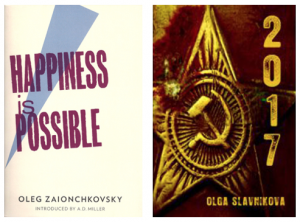
Oleg Zaionchkovski – Happiness is possible

new sale

Bulgarian rights sold to Aviana

„Artlessness is the defining aspect of Zaionchkovsky’s diction: the absolute harmony of style and dramatic development seems to be entirely natural, it “happens” to the author in the same way as various events constantly happen to his character.“
ANDREW BROMFIELD

Mikhail Vizel – Pushkin in Quarantine

new representation

nothing resembles our year 2020 more than Pushkin‘s quarantine of 1830

Cholera is raging in Russia and parts of the country are in lockdown. The Russian poet Alexander Pushkin, already famous at the time, is stuck in Boldino for three months. The planned wedding with his fiancée Natalia Goncharova has to be postponed. He tries twice in vain to get to her in Moscow. Pushkin is worried. And with jealousy that the bride might jump off him. He is furious because, despite bribing the police, he is unable to bypass the roadblocks to Moscow.

Mikhail Vizel in his book PUSHKIN.BOLDINO.QUARANTINE reconstructs the exciting chronology of the Boldino autumn in a witty, amusing and analytically accurate way. Commenting letters from Pushkin to his bride, we are introduced to his love affair, which has to pass an extraordinary stress test during lockdown. We can not only chronologically follow Pushkin‘s passionate ups and downs during quarantine, but finally experience them with compassion based on our own Covid experience.

Aleksandr Grigorenko – Mebet

new publication

English translation published by Glagoslav

The first part of Aleksandr Grigorenko’s novel MEBET seems to take the reader off into an ethnic epic about a great hunter and warrior with all the myths of the Taiga: witches, talking dogs, huge bears, hoards of spirits. Yet the second part reveals itself as a grandiose literary reflection of the first and we realise that this no folklore novel, but a timeless novel about destiny and humanity, culminating in a powerful, universal catharsis.

Aleksei Slapovski – The Unknown

new publication

Hungarian translation published by Slovart

The subtitle of Aleksei Slapovski’s most recent book THE UNKNOWN is: „Novel of a Century 1917 to 2017“. And indeed, the story begins with Nikolai Smirnov’s entry into his diary on the 17th December 1917 and ends with a letter from Gleb Smirnov to his father Victor in 2017. Thus the novel is also a family saga spanning five generations. No judgement of individual fate, instead empathy with many members of the family who recognize that they are on their way into the unknown.

In its polyphonic, multi-faceted concept a courageous response to recent political reflexives in Russia where a single version of the so called patriotic past is printed in the school books.